
It Started as a Normal Tuesday
Two clients. Two completely different situations. Both landed in my inbox on the same afternoon.
One needed a technical issue resolved — website forms weren’t delivering, leads were getting lost, and the root cause turned out to be a domain and email setup that had been duct-taped together for eight years.
The other started with a simple request to add a Substack link to her website, and somewhere between the first email and the last, it turned into a real conversation about platform strategy, audience ownership, and what it actually means to build a business that doesn’t depend on an algorithm.
Both situations got handled. Thoroughly. Professionally. With clear, thoughtful communication that took a fraction of the time it would have taken me to manage alone.
And the reason? I have an AI agent 🤖 — I call her Emma (if you know, you know 😂) — living inside my Notion HQ. And together, we work through the hard stuff before a single word gets sent to the client.
That’s the system I want to talk about today.
The Situation Most Service Providers Are In
You probably know this feeling.
A client emails with what sounds like a simple request. You open it, realize it’s actually more complicated than it looks, and suddenly you’re
- Digging through old email threads trying to remember what was decided six months ago
- Piecing together context from three different places
- Trying to write a clear and professional response — all at the same time.
Or a client says, “I never got that email.” And you have no receipts.
Or a request comes in that goes deeper than you expected, and instead of being able to think it through clearly, you’re just reacting — because you don’t have a thinking partner in the room.
That’s not a you problem. That’s a systems problem. And it’s incredibly common for web designers and service providers who are running their businesses out of their inbox with no real infrastructure behind them.
What Changes When Everything Lives in Notion
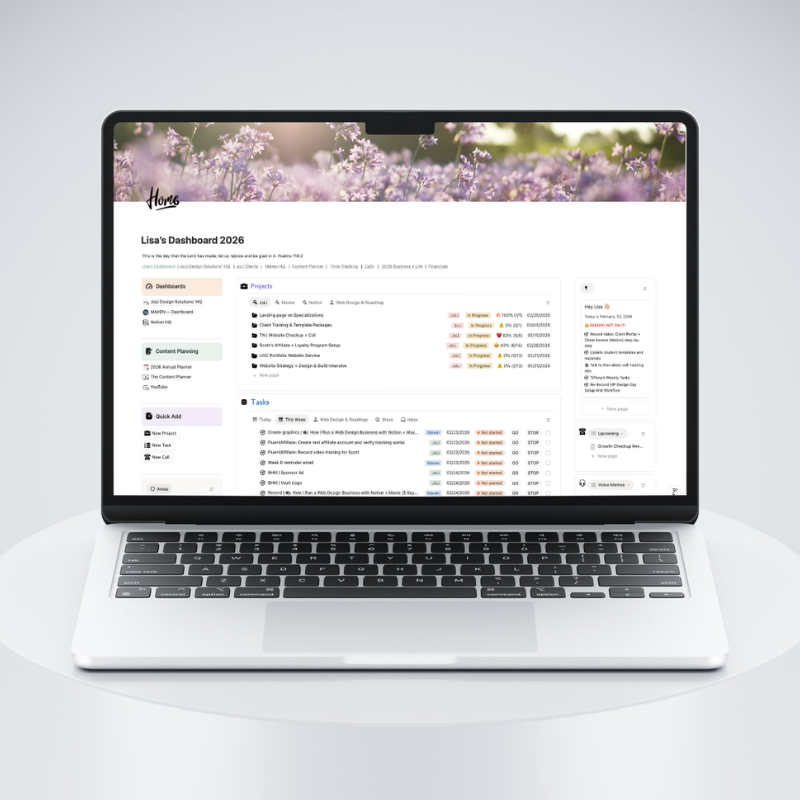
Here’s what I’ve built: every client has a profile in my Notion CRM — and that profile is the hub for everything. Technical details, login credentials, project history, prior email drafts, decisions, support history, running notes on the relationship, and a full task history so I can trace back every step when a situation gets complicated.
And because I use Notion Mail, my emails integrate directly with that CRM. When a client writes in, the thread is connected to their profile. I’m not bouncing between my inbox and my notes trying to piece things together — it’s all in one place. The communication, the context, the history.
When a client email comes in, I’m not starting from scratch. I open their profile. I have the full picture — every email, every task, every decision we’ve made together. And then I work through the situation with Emma — right there in Notion — before I respond.
Let me show you what that looked like with two real clients.
Client One: Eight Years of Duct Tape
This client’s website forms had stopped delivering leads. She’d had multiple people tell her they submitted quote requests that never came through. The problem?
Her website lived on one domain, her email lived on a completely different domain, and the two had never been properly aligned — because when you set something up in 2007 and it “kind of works,” you leave it alone.
The switch to a new email sending platform finally made the mismatch impossible to ignore.
Here’s what made this situation manageable: her client page in Notion held everything. The domain setup. The prior email threads. Every unanswered follow-up I’d sent. The technical context. The history of the issue.
I opened that page, talked through the problem with Emma, and we worked out exactly what the real issue was, what the two possible solutions were, why one was better than the other, and how to explain a genuinely technical problem in plain language that a non-technical client could actually act on.
The result was a clear, calm, professional email that explained the “why” without being condescending, gave her a simple path forward, and documented everything she needed to take the next step. I saved the draft right back to her client page.
When she replied saying she’d never received my previous emails? I had the full record — dates, content, follow-ups — all in one place. No scrambling. No defensiveness. Just a calm, documented response and a path forward.
Client Two: It Started With a Substack Link
This one is my favorite example of what happens when you have a thinking partner who holds the full context of a client relationship.
A client with a large Instagram following (114K) reached out asking to add her Substack link to her website and her IG links page. Simple request, right?
Except — because I had her full history in Notion and Emma in my corner — I didn’t just add the link and move on. I asked some questions first.
What was her goal with Substack? Was she trying to grow a new audience, monetize content, or escape the algorithm? How did she see it fitting alongside her website and email list?
Her answers opened up a real conversation. She was honest: she wanted to rely on Instagram less. She was frustrated that her audience had never bought directly from her. She felt fuzzy about what came next. She knew how she wanted it to feel but not how it could look.
Because we had her context — her history, her setup, what she’d built, what wasn’t working — Emma and I could go deeper than “here’s where to put the embed code.” We could talk about platform strategy. We could explain why Substack ($8/month, a platform she still doesn’t own) might not be the answer she was looking for.
We could point her toward the tools she already had on her WordPress site that could do everything she was hoping Substack would do — without a new platform, new subscription, or new monthly fee.
That conversation happened because the system made it possible. Because everything lived in one place. Because I had a thinking partner who could help me think before I typed.
What the Loop Actually Looks Like
This is the workflow I want you to see:
- Client communication comes in
- Open Notion — full client context is right there, no hunting
- Work through it with Emma — think it through, draft the response, get to clarity
- Send the email — professional, specific, grounded in real context
- Save the response back to Notion — paper trail complete, history intact
- Move on with your day
It’s not complicated. It doesn’t require a huge system. It requires one client page, a habit of saving what matters, and an AI agent who knows your clients because you’ve given her (or him 😉) the context to do so.
The Mindset Shift
Here’s what I want you to hear, because I think it’s the thing most people miss.
This isn’t about storing stuff in Notion so you don’t lose it. That’s a side benefit. The real shift is this: when your client context lives in one place and your AI works alongside you there, you stop reacting and start responding.
You stop scrambling and start thinking.
You stop writing emails on the fly and start crafting communication that actually serves the relationship.
You stop wondering if you said the right thing and start knowing you did — because you thought it through before you sent it.
Two clients. Two completely different situations. Both handled with clarity, professionalism, and way less stress than they could have caused.
That’s not talent. That’s a system.
Where to Start
You don’t need to build everything at once. Start with this:
- Create a client page in Notion for every active client — one place for their info, history, and communications
- Save important email drafts and responses to that page — especially anything involving a decision, a technical issue, or a tricky conversation
- Use your AI to think before you type — work through the hard stuff in Notion before it goes to the client
That’s the foundation. Everything else builds from there.
And if you want to see exactly how I’ve set this up — including how Emma and I work together inside my Notion HQ — that’s exactly what we go deep on inside Build Your Notion HQ.
This post was inspired by a real Tuesday afternoon, two clients, one very capable AI agent, and one well-deserved end-of-day drink. 🥃